Assassination of Archduke Franz Ferdinand
A brutal 1903 palace regicide transformed Serbia from a quiet neighbor into a revolutionary engine for a "Greater Serbia."
A brutal 1903 palace regicide transformed Serbia from a quiet neighbor into a revolutionary engine for a "Greater Serbia."
The roots of the 1914 assassination lie in a midnight coup eleven years earlier. In 1903, Serbian military officers stormed the Royal Palace, shot the pro-Austrian King Alexander thirty times, and threw his body out of a window. This ended the Obrenović dynasty and installed the Karađorđević house, which was fiercely nationalist and aligned with Russia. This regime change shifted Serbia’s focus toward reclaiming "lost" 14th-century territories and undermining Austro-Hungarian influence in the Balkans.
The tension escalated in 1908 when Austria-Hungary formally annexed Bosnia and Herzegovina, land that Serbian nationalists believed should be part of a South Slav state. This "Bosnian Crisis" turned local resentment into a structured revolutionary movement. Cultural organizations like Narodna Odbrana began operating as fronts for underground activities, creating a fertile environment for radicalizing the young population against what they viewed as colonial Habsburg rule.
The assassins were radicalized teenagers who viewed their violence as a spiritual re-enactment of Serbian folklore.
The assassins were radicalized teenagers who viewed their violence as a spiritual re-enactment of Serbian folklore.
While orchestrated by older figures, the actual "Young Bosnia" assassination team consisted mostly of students under the age of 20. These young men were deeply immersed in the "Kosovo Myth," specifically the heroic ideal of Miloš Obilić, who assassinated an Ottoman Sultan in 1389. For Gavrilo Princip and his peers, the date of the Archduke's visit—June 28, the feast of St. Vitus (Vidovdan)—was a sacred anniversary of Serbian sacrifice that demanded a modern-day act of martyrdom.
The group was inspired by the 1910 failed assassination attempt by Bogdan Žerajić, who became a cult figure to the students. Princip spent nights reflecting at Žerajić’s grave, eventually deciding that "social revolution" and "national liberation" were worth any price. This generational shift toward nihilism and martyrdom meant that the assassins were not just political actors, but individuals seeking to fulfill a perceived historical destiny through "propaganda of the deed."
The plot functioned as a "Deep State" operation, fueled by Serbian military intelligence and the secret Black Hand society.
The plot functioned as a "Deep State" operation, fueled by Serbian military intelligence and the secret Black Hand society.
The student assassins provided the willpower, but the "Black Hand" (a secret society led by Serbian military intelligence chief Dragutin Dimitrijević, or "Apis") provided the hardware. The conspirators were trained in Belgrade by Serbian majors and provided with FN Model 1910 pistols and bombs. They were smuggled across the border via a clandestine network of safe-houses and agents typically used for military infiltration, proving the plot had high-level state-adjacent support.
The relationship between the student assassins and the Black Hand was complex and sometimes redundant. Two separate plots converged in the spring of 1914: one initiated by the students in Belgrade and another by the Black Hand leadership. While the Black Hand initially targeted the Governor of Bosnia, they eventually pivoted to the Archduke, recognizing that his death would provide a much more explosive provocation to the Austro-Hungarian Empire.
Franz Ferdinand’s plan to reform the Empire made him a more dangerous target to radicals than a tyrant would have been.
Franz Ferdinand’s plan to reform the Empire made him a more dangerous target to radicals than a tyrant would have been.
Counter-intuitively, the Archduke was targeted not because he was a warmonger, but because he was a reformer. He advocated for "Trialism," a plan to reorganize the Austro-Hungarian Empire into a triple monarchy that would give Slavs a status equal to Germans and Hungarians. Serbian irredentists feared that if the Archduke succeeded, the Slavic citizens of the Empire would be satisfied with federalism and lose interest in joining a "Greater Serbia."
The Archduke’s presence in Sarajevo on the fatal day was also an act of personal devotion. Because his wife, Sophie, was of lower aristocratic rank, she was often humiliated by royal protocol in Vienna. However, she could enjoy the recognition of his rank when he acted in a military capacity. Sarajevo offered a rare opportunity for them to ride side-by-side in an open carriage. As historian A. J. P. Taylor noted, "for love, did the Archduke go to his death."
The legal aftermath exposed a split in historical memory that remains divided along ethnic lines today.
The legal aftermath exposed a split in historical memory that remains divided along ethnic lines today.
Following the assassination, the attackers were tried in Sarajevo. Because Gavrilo Princip was only 19 at the time of the crime, Austro-Hungarian law prohibited his execution; he was sentenced to 20 years in prison, where he later died of tuberculosis. Meanwhile, the Serbian government eventually turned on the Black Hand, executing its leaders in 1917 on fabricated charges to distance the state from the assassination as the tide of World War I shifted.
Today, the legacy of the event remains a geopolitical fault line. In the successor states of Yugoslavia, public opinion of Princip is fractured: some view him as a liberator and national hero who ended centuries of foreign occupation, while others see him as a state-sponsored terrorist whose actions triggered a global catastrophe. This divergence ensures that the events of June 28, 1914, remain as much a matter of modern identity as they are of historical record.

Image from Wikipedia
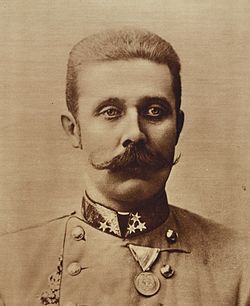
Archduke Franz Ferdinand of Austria

Photograph of the Archduke and his wife emerging from the Sarajevo Town Hall to board their car, a few minutes before the assassination

Gavrilo Princip outside the courthouse

Route of the assassins from Belgrade to Sarajevo

Route of the weapons from Belgrade to Sarajevo

The 1911 Gräf & Stift 28/32 PS Double Phaeton in which Archduke Franz Ferdinand was riding at the time of his assassination, Museum of Military History, Vienna (2023)

A map annotated with the events of 28 June 1914, from an official report

A map showing the route of Archduke Franz Ferdinand's motorcade

Arrest of a suspect in Sarajevo during the aftermath of the assassination

FN Model 1910 pistol (s/n 19074) displayed at the Museum of Military History, Vienna, 2009
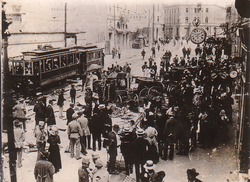
Crowds on the streets in the aftermath of the Anti-Serb riots in Sarajevo, 29 June 1914

The Sarajevo trial in progress. Princip is seated in the center of the first row.

Photograph of Vaso Čubrilović taken in 1914 during the Sarajevo trial (October 1914) by an unknown photographer.

Indictees at the Salonika trial, after the verdict