Apocalypse Now
A river journey through the Vietnam War serves as a psychological descent into the "heart of darkness."
A river journey through the Vietnam War serves as a psychological descent into the "heart of darkness."
Loosely inspired by Joseph Conrad’s 1899 novella, the film replaces 19th-century Congo with the Vietnam War. Captain Willard (Martin Sheen) is sent on a clandestine mission to "terminate with extreme prejudice" Colonel Kurtz (Marlon Brando), a highly decorated officer who has gone rogue. Kurtz has established a private army in the Cambodian jungle, where he is worshipped as a god-like figure by local tribes and American defectors.
The narrative structure follows a river patrol boat’s slow crawl up the Nùng River, moving from the "civilized" chaos of American military operations—typified by the surf-obsessed Lieutenant Colonel Kilgore—into a surreal, lawless void. As the crew encounters tigers, spears, and drug-induced hallucinations, the traditional military hierarchy dissolves, mirroring Willard's internal struggle as he reads Kurtz’s dossier and begins to sympathize with the man he is meant to kill.
The film’s legendary "production apocalypse" nearly destroyed its cast and director.
The film’s legendary "production apocalypse" nearly destroyed its cast and director.
Originally scheduled for a five-month shoot in the Philippines, the production lasted over a year due to a sequence of catastrophic events. Expensive sets were leveled by a typhoon, and director Francis Ford Coppola was forced to edit over a million feet of film. The chaos was so absolute that it was later chronicled in the famous documentary Hearts of Darkness: A Filmmaker's Apocalypse, suggesting the making of the movie was as grueling as the war it depicted.
The human cost was equally high. Martin Sheen suffered a breakdown and a near-fatal heart attack on location, requiring his brother to stand in for several scenes. Marlon Brando arrived on set significantly overweight and unprepared, forcing Coppola to film him primarily in shadows and improvising his dialogue. These difficulties contributed to the film's ballooning budget and its reputation as one of the most troubled—yet ultimately successful—productions in Hollywood history.
Coppola reimagined Victorian-era colonialism as American military interventionism.
Coppola reimagined Victorian-era colonialism as American military interventionism.
While the film retains iconic lines and themes from Conrad’s novella—such as Kurtz’s final words, "The horror! The horror!"—it shifts the critique from European exploitation of Africa to American involvement in Southeast Asia. Coppola preserves the novella’s skepticism of "civilization," using the insanity of the Vietnam battlefield to argue that the line between organized warfare and Kurtz’s "insane" methods is thinner than the military high command admits.
Beyond Conrad, the film draws on high-culture references like Dante’s Inferno and T.S. Eliot's poetry to elevate the war movie genre into a grander meditation on the human psyche. Even the character of Kurtz was influenced by reality; he was partially modeled on Tony Poe, a real-life CIA paramilitary officer known for his unorthodox and savage tactics in the "Secret War" in Laos.
Real-life physical and psychological distress fueled the film's most iconic performances.
Real-life physical and psychological distress fueled the film's most iconic performances.
The intensity seen on screen was often unsimulated. The film’s opening scene, where Willard smashes a mirror and smears himself with blood, was filmed on Martin Sheen’s 36th birthday while he was heavily intoxicated. Sheen later described the scene as a "spontaneous exorcism" of his own struggles with alcoholism. This raw energy set the tone for a film that feels increasingly unhinged as it progresses.
Supporting roles also broke traditional boundaries. Laurence Fishburne lied about his age to get the part, beginning the shoot at age 14 and finishing it at 17. Meanwhile, Robert Duvall’s portrayal of Kilgore became a cultural touchstone, balancing the absurdity of surfing during a napalm strike with the chilling efficiency of a career soldier. These performances, captured by Vittorio Storaro’s Oscar-winning cinematography, created a visual language for the Vietnam War that persists in the public imagination today.
Initial critical polarization gave way to a legacy of technical mastery and multiple definitive versions.
Initial critical polarization gave way to a legacy of technical mastery and multiple definitive versions.
Upon its 1979 release, Apocalypse Now divided critics. While many praised its technical brilliance and sound design, others found the philosophical conclusion in Kurtz’s compound to be anticlimactic or intellectually disappointing. Despite this, it won the Palme d'Or at Cannes while still "unfinished" and eventually earned eight Academy Award nominations, solidifying its status as a masterpiece of the New Hollywood era.
The film has continued to evolve long after its premiere. Coppola has released two major re-edits: Apocalypse Now Redux (2001), which restored 49 minutes of footage including a lengthy French plantation sequence, and Apocalypse Now Final Cut (2019). The Final Cut represents Coppola’s preferred vision, balancing the lean intensity of the original theatrical release with the expanded thematic depth of the Redux.
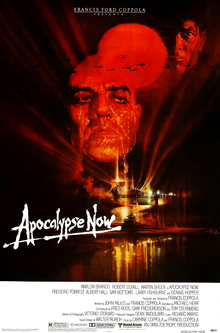
Image from Wikipedia

The 1979 Cannes Film Festival Palme d'Or was awarded to Apocalypse Now.

May 1, 2010, cover of the Economist newspaper, illustrating the euro area crisis with imagery from the movie, attests to the film's pervasive cultural impact.