American Gothic
Grant Wood found inspiration in a "structural absurdity" and cast his dentist to inhabit it
Grant Wood found inspiration in a "structural absurdity" and cast his dentist to inhabit it
In 1930, Grant Wood spotted a small white house in Eldon, Iowa, built in the Carpenter Gothic style. He was struck by the "borrowed pretentiousness" of placing a grand, pointed medieval window in such a flimsy, "cardboardy" frame house. Wood didn't just want to paint the architecture; he wanted to paint the specific kind of people he "fancied should live in that house."
To populate his vision, Wood avoided professional models, instead casting his sister, Nan Wood Graham, and his dentist, Dr. Byron McKeeby. Though the public often mistook them for a husband and wife, Wood eventually clarified they were a father and his "grown-up daughter." The costumes were meticulously curated to evoke a fading era: Nan wore a colonial-print apron with rickrack trim salvaged from an old family dress, while the dentist donned a suit jacket over overalls, clutching a pitchfork that Wood saw as an extension of the man’s rigid face.
The painting’s visual power is anchored by a strict, repeating geometry of vertical lines
The painting’s visual power is anchored by a strict, repeating geometry of vertical lines
The "Gothic" in the title refers not just to the house's window, but to the painting’s pervasive verticality. Wood created a rhythmic visual echo: the three-pronged pitchfork is mirrored in the stitching of the man’s overalls, the stripes of his shirt, the long ogive of the attic window, and even the elongated structure of the subjects' faces. This repetition creates a sense of stern, unyielding order.
Even the flora is intentional. On the porch sit a "mother-in-law’s tongue" and a "beefsteak begonia"—the same plants Wood included in a 1929 portrait of his mother. By incorporating these specific domestic elements, Wood grounded the stylized, almost "cardboardy" architecture in the concrete details of 20th-century rural Americana, balancing high-concept design with gritty, local reality.
A local backlash against "pinched" caricatures gave way to a national symbol of resilience
A local backlash against "pinched" caricatures gave way to a national symbol of resilience
When the painting was first published in the Cedar Rapids Gazette, local Iowans were furious. They saw the "pinched, grim-faced" duo as a biting satire of Midwesterners as puritanical "Bible-thumpers." Early art critics agreed, grouping Wood with contemporary novelists who were deconstructing the myth of the idyllic small town. Wood defended himself, claiming his time studying in Paris had actually taught him to appreciate the unique character of his home state.
The painting’s meaning shifted dramatically with the onset of the Great Depression. The public stopped seeing the couple as a caricature of narrow-mindedness and began viewing them as symbols of the "steadfast American pioneer spirit." Wood leaned into this new interpretation, renouncing his bohemian European training to join the Regionalist movement. He famously quipped, "All the good ideas I've ever had came to me while I was milking a cow," successfully rebranding the painting as an homage to rural endurance.
Beneath the rural surface, scholars see traces of Victorian mourning and Roman mythology
Beneath the rural surface, scholars see traces of Victorian mourning and Roman mythology
Modern interpretations suggest the painting is far more than a simple rural portrait. Some art historians argue it is a "mourning portrait," noting that the house's curtains are drawn tight in the middle of the day—a Victorian death custom. In this light, the woman’s black dress and distant gaze suggest she is grieving for the man beside her, perhaps a reflection of Wood losing his own father at age ten.
Other critics find hidden classical roots, comparing the pair to Pluto and Proserpina, the Roman gods of the underworld. In this reading, the pitchfork becomes a bident, the guardian’s tool, and the woman’s cameo brooch depicts Proserpina herself. Whether viewed as an Egyptian-style funerary pose or a mythological allegory, these theories suggest Wood was tapping into deep, universal themes of life, death, and the soil.
The image has evolved into a universal visual shorthand for American identity through parody
The image has evolved into a universal visual shorthand for American identity through parody
American Gothic is arguably the most parodied work in American art history. Its transition from a serious painting to a cultural meme began as early as 1942, when photographer Gordon Parks used the composition to highlight racial inequality in a photo of a government charwoman. Since then, it has become a staple of pop culture, appearing in everything from The Simpsons and The Rocky Horror Picture Show to marketing campaigns for smartphones.
The painting's staying power lies in its versatility. Because the figures are so stoic and the setting so iconic, the image serves as an empty vessel for whatever message the parodist wants to convey—be it domesticity, stubbornness, or tradition. By being constantly mocked and recreated, the "pinched" farmer and his daughter have achieved a level of immortality that few other American artworks can claim.

A painting of a man and woman with stern expessions standing side-by-side in front of a white house. The man holds a pitch fork.

Grant Wood, Self-portrait, 1932, Figge Art Museum
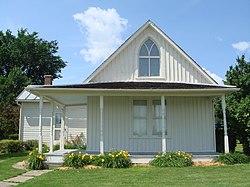
The Dibble House, Eldon, Iowa