Abstract expressionism
World War II shifted the global art capital from Paris to New York City
World War II shifted the global art capital from Paris to New York City
The destruction of Europe and the influx of exiled artists—including heavyweights like Max Ernst and André Breton—transformed New York into the new center of the avant-garde. This wasn't just a change of scenery; it was a psychological break. American artists, emerging from the trauma of the Great Depression and the horrors of war, felt that traditional figurative painting was no longer capable of expressing the modern condition.
The resulting "New York School" moved away from the refined aesthetics of the French tradition. They favored a raw, unpolished energy that felt uniquely American. For the first time, American art wasn't looking back at Europe for approval; instead, it was setting a pace that the rest of the world was forced to follow.
The movement split into "Action Painting" and "Color Field" styles
The movement split into "Action Painting" and "Color Field" styles
Abstract Expressionism is rarely a single look; it is better understood as two distinct emotional strategies. The first, "Action Painting," led by Jackson Pollock and Willem de Kooning, treated the canvas as an arena. The painting was not a picture of an object, but a physical record of an event—the drips, splashes, and aggressive brushstrokes were evidence of the artist’s movement through time and space.
In contrast, "Color Field" painters like Mark Rothko and Barnett Newman sought a meditative stillness. They utilized massive planes of saturated color to evoke a sense of the "sublime." While Action Painting was about the kinetic energy of the individual, Color Field was about creating a religious or spiritual environment that could overwhelm the viewer’s senses through pure optics.
Artists mined the subconscious to find a universal, mythic language
Artists mined the subconscious to find a universal, mythic language
Influenced heavily by Jungian psychology and Surrealist "automatism," these artists believed that the most honest art came from the unconscious mind. By abandoning planned compositions and recognizable subjects, they hoped to tap into primitive archetypes and universal human emotions—fear, ecstasy, and grief—that bypassed the need for a shared written language.
This was a move toward the "heroic." The Abstract Expressionists didn't want to paint a landscape; they wanted to paint the feeling of a landscape. They viewed the act of painting as a struggle to bring something hidden into the light, treating the artist as a sort of modern shaman or philosopher.
Massive scale was used to destroy the "window" and create an "environment"
Massive scale was used to destroy the "window" and create an "environment"
Before this movement, most paintings functioned like windows—you stood back and looked into them. Abstract Expressionists changed the physics of viewing by working on canvases so large they dominated the viewer's peripheral vision. When you stand in front of a ten-foot-tall Rothko, you are no longer observing a discrete object; you are standing inside its atmosphere.
This scale was essential for the "all-over" composition style. By treating every inch of the canvas with equal importance, artists like Pollock eliminated the traditional focal point. This forced the eye to wander continuously, mirroring the restless, uncontainable nature of the human mind.
The movement became an accidental weapon of American Cold War soft power
The movement became an accidental weapon of American Cold War soft power
In a strange twist of history, this fiercely individualistic art was championed by the CIA and the US government as a symbol of Western freedom. During the Cold War, the "wild" and "unregulated" nature of Abstract Expressionism was held up as a direct contrast to the rigid, state-mandated "Socialist Realism" of the Soviet Union.
While many of the artists themselves were left-leaning or apolitical, their work was exported globally in massive exhibitions to prove that America was a land of total intellectual and creative liberty. The very "meaninglessness" of the abstract shapes made them the perfect vessel for whatever political message the era required.
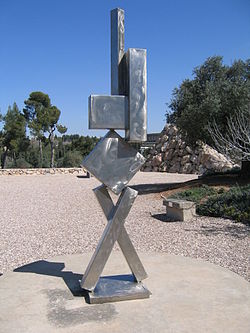
David Smith, Cubi VI (1963), Israel Museum, Jerusalem. David Smith was one of the most influential American sculptors of the 20th century.

Barnett Newman, Onement 1, 1948. During the 1940s Barnett Newman wrote several articles about the new American painting.

Richard Pousette-Dart, Symphony No. 1, The Transcendental, 1941–42

Arshile Gorky, The Liver is the Cock's Comb (1944), oil on canvas, 731⁄4 × 98" (186 × 249 cm) Albright–Knox Art Gallery, Buffalo, New York. Gorky was an Armenian-born American painter who had a seminal influence on abstract expressionism. De Kooning said: "I met a lot of artists — but then I met Gorky... He had an extraordinary gift for hitting the nail on the head; remarkable. So I immediately attached myself to him and we became very good friends."

Boon by James Brooks, 1957, Tate Gallery

William Baziotes, Cyclops, 1947, oil on canvas, Chicago Art Institute. Baziotes' abstract expressionist works show the influence of Surrealism

Mark di Suvero, Aurora, 1992–1993

Jean-Paul Riopelle, 1951, Untitled, oil on canvas, 54 x 64.7 cm (21 1/4 x 25 1/2 in.), private collection

Richard Stankiewicz, Detail of Figure; 1956; steel, iron, and concrete; in the collection of the Hirshhorn Museum and Sculpture Garden

John Chamberlain, S, 1959, Hirshhorn Museum and Sculpture Garden, Washington, D.C.

Isamu Noguchi, The Cry, 1959, Kröller-Müller Museum Sculpture Park, Otterlo, Netherlands

Louise Bourgeois, Maman, 1999, outside Museo Guggenheim