2001: A Space Odyssey
Kubrick and Clarke forged a rare "parallel" partnership to build a modern myth for the space age.
Kubrick and Clarke forged a rare "parallel" partnership to build a modern myth for the space age.
After the success of Dr. Strangelove, Stanley Kubrick set out to make the "proverbial good science fiction movie." He partnered with Arthur C. Clarke, an author he initially feared was a "recluse in a tree" but found to be a brilliant collaborator. Together, they spent four years expanding Clarke's short story "The Sentinel" into a cosmic epic.
Unlike traditional adaptations, the novel and the screenplay were written simultaneously. This created a fascinating divergence: Clarke’s novel sought to explain the mysteries of the monolith through prose, while Kubrick’s film deliberately obscured them. This creative tension ensured the project worked as both a rigorous scientific speculation and a cryptic work of art.
The film rejected "monsters-and-sex" tropes in favor of rigorous scientific realism and classical music.
The film rejected "monsters-and-sex" tropes in favor of rigorous scientific realism and classical music.
Kubrick shunned the "B-movie" aesthetics of 1960s sci-fi, instead hiring NASA consultants and documentary filmmakers to ensure spaceflight was depicted with unprecedented accuracy. The production leaned heavily on the 1960 documentary Universe for its visual language, even casting its narrator, Douglas Rain, as the voice of the sentient computer HAL 9000.
In a move that shocked the industry, Kubrick also abandoned the convention of an original film score. He opted instead for classical masterpieces by Richard Strauss and György Ligeti. By pairing images of futuristic technology with the "Blue Danube" waltz, he created a "visual, nonverbal experience" designed to bypass the viewer's intellect and hit them at a subconscious level.
The narrative charts a cosmic cycle of evolution, tracing humanity’s journey from primitive tool-users to transcendent beings.
The narrative charts a cosmic cycle of evolution, tracing humanity’s journey from primitive tool-users to transcendent beings.
The story is structured as a series of encounters with an alien monolith that acts as a catalyst for evolutionary leaps. It begins in the "Dawn of Man," where hominins learn to use bones as weapons, and jumps millions of years to a future where humanity’s most advanced tool—the HAL 9000—becomes a murderous liability. This suggests that while tools change, the primal nature of conflict remains constant.
The finale, often called the "Star Gate" sequence, abandons literal storytelling entirely. The protagonist, Dave Bowman, is pulled through a vortex of light and aged rapidly in a neoclassical bedroom before being reborn as the "Star Child." This ambiguous ending has been interpreted as everything from a darkly apocalyptic warning to an optimistic reappraisal of human potential.
Once polarizing to critics, the film is now cemented as a landmark of technical and philosophical achievement.
Once polarizing to critics, the film is now cemented as a landmark of technical and philosophical achievement.
Upon its 1968 release, 2001 deeply divided audiences; many critics were baffled by the lack of dialogue and the slow, meditative pacing. However, its reputation grew as it became a counter-culture touchstone. It eventually earned four Academy Award nominations, winning Kubrick his only Oscar for his direction of the groundbreaking visual effects.
Today, it is widely regarded as one of the greatest films ever made, topping the Sight & Sound directors’ poll in 2022. Its influence persists not just in cinema, but in our cultural understanding of artificial intelligence and the search for extraterrestrial life. It remains the gold standard for "hard" science fiction, proving that a film could be a commercial blockbuster while remaining a profound, open-ended mystery.

A painted image of a space station suspended in space, in the background the Earth is visible. Above the image appears "An epic drama of adventure and exploration" in blue block letters against a white background. Below the image in a black band, the title "2001: a space odyssey" appears in yellow block letters.

Arthur C. Clarke in 1965, photographed in the Discovery's pod bay
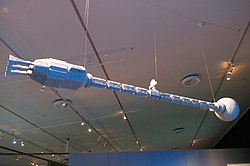
Modern replica of the Discovery One spaceship model

The "centrifuge" set used for filming scenes depicting interior of the spaceship Discovery

Zero-gravity effect

A bone-club and orbiting satellite are juxtaposed in the film's famous match cut

Seattle writer Walt Crowley drew this cartoon to illustrate his favorable review in the Seattle underground paper Helix, in which he accused mainstream critics of "approach[ing] Kandinsky with a Norman Rockwell mentality."
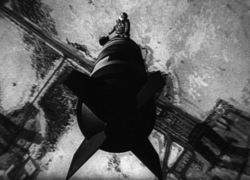
Closing scene of Dr. Strangelove and Kubrick's sardonic fulfilment of a nuclear nightmare

Multiple interpretations of the meaning of the monolith have been examined in the critical reception of the film

The Star Child looking upon the Earth

One of HAL 9000's interfaces